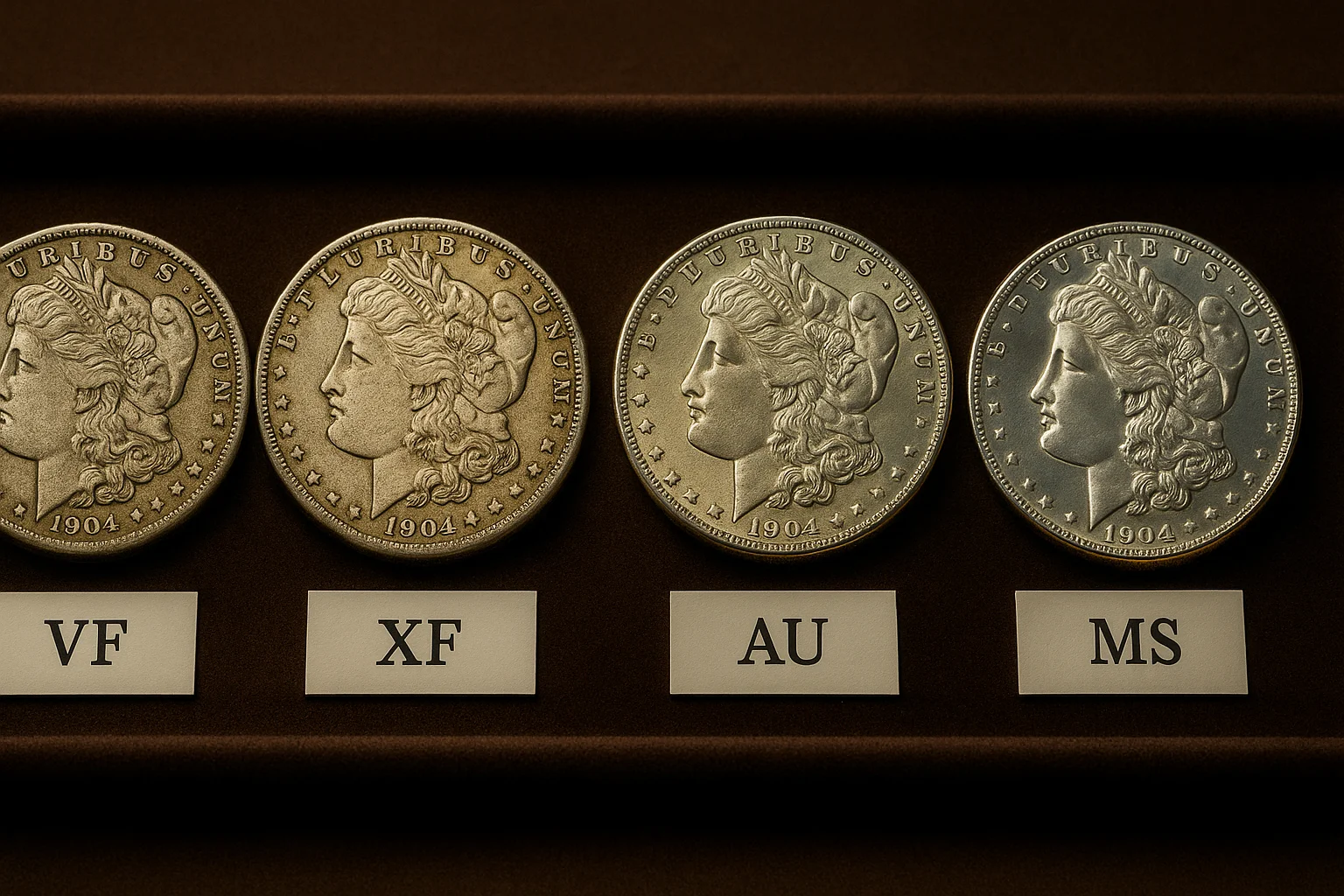
The difference often lies in the details that feel almost invisible.
Collectors in 2026 face a market where a single 1917 dime might cost $10 while another sells for $35,000.
Technological inconsistencies during the First World War era created a spectrum of quality that defines the modern 1917 Mercury Dime value.
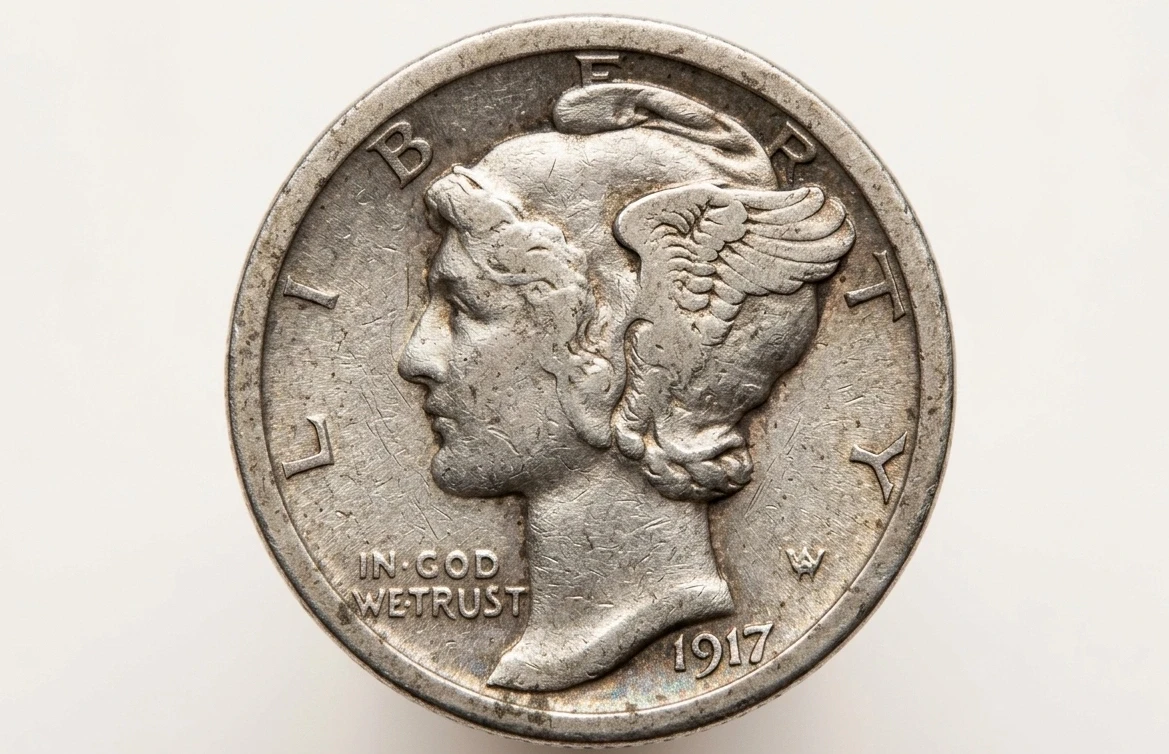
Technical Standards and Composition
Minting operations in 1917 followed strict legal requirements set by the United States government.
Material properties of the coinage alloy determine how well surviving pieces have aged over the last century.
Core Specifications:
- Metal Mix: 90% Silver, 10% Copper
- Total Weight: 2.50 grams
- Weight Tolerance: 0.06 grams
- Edge Design: Reeded
- Mint Locations: Philadelphia, Denver, San Francisco
Diameter measures exactly 17.91 millimeters.
Thickness of the silver blank is recorded at 1.35 millimeters.
High silver content makes the coin soft, leading to frequent marks when striking other hard objects.
Mintage Volumes and Location Rarity
Production levels in 1917 varied significantly across the three active minting facilities.
Supply levels directly influence the starting bids at the current 2026 auctions.
- Philadelphia (No Mint Mark): 55,068,000 units
- Denver (D Mark): 9,402,000 units
- San Francisco (S Mark): 27,357,000 units
Total Emission → 91,827,000 pieces.
Denver issues lead the price charts because of chronic production failures during that specific year.
Finding a sharp, high-grade Denver coin in 2026 is exponentially harder than finding a Philadelphia equivalent.
The “Full Bands” (FB) Quality Benchmark
Horizontal lines on the reverse fasces serve as the ultimate test for a Mercury Dime’s value inside the free coin scanner.
Presence of this feature proves that the minting press used maximum pressure during contact.
- Standard Strike: Central horizontal bands appear flat or merged into the surrounding metal.
- Full Bands Status: A clear, deep split exists between the pairs of horizontal bands.
- Value Impact: Receiving an FB designation increases market price by 300% to 600% on average.
Professional traders in 2026 avoid non-FB coins when building high-liquidity investment portfolios.
Weak strikes on the reverse center can turn a potentially rare coin into a common low-value asset.
Current Market Pricing
Valuation for 1917 dimes scales based on the mint location and the presence of verified Full Bands.
| Grade | 1917 (Phila) | 1917-D | 1917-S |
| VG8 | $4 | $12 | $6 |
| VF20 | $9 | $55 | $25 |
| MS63 | $65 | $480 | $220 |
| MS65 FB | $310 | $4,200 | $1,150 |
| MS67 FB | $1,850 | $22,500 | $8,400 |
Most aggressive price gaps appear in the Denver MS67 FB category.
Annual appreciation for these rarities has averaged 8.5% over the last three fiscal cycles.
Worn Philadelphia coins show almost zero growth, often selling at silver melt value.
Historic Sales and Auction Records
Top-tier sales set the ceiling for what collectors are willing to pay for 1917 issues.
These milestones guide the valuation of elite numismatic portfolios in 2026.
- 1917-D MS67 FB (PCGS): Sold for $32,900 previously, current 2026 appraisal sits at $35,000.
- 1917-S MS67+ FB (NGC): Realized $11,400 during the most recent spring auction session.
- 1917 MS68 FB (Phila): Set a record at $5,750 due to its exceptional original luster.
Auction house fees typically add another 17% to 20% to these hammer prices.
Investors must account for these costs when calculating potential exit profits.
Physical Flaws and Grading Logic
Visual analysis identifies specific imperfections that lower the final numerical grade.
Damage to Liberty’s portrait is penalized more heavily than marks on the reverse side.
Flaw Type → Market Consequence:
- Bag Marks → Reducing value by 40–70% if found on focal areas like the cheek.
- Hidden Cleaning (Hairlines) → Crashing the price to raw silver value due to failed certification.
- Environmental Damage → Resulting in a near-total loss of collector value.
- Weak Strike → Preventing an FB label even if the coin has never circulated.
Using a wrench to open plastic coin slabs without professional tools is dangerous.
Any slip leaves deep gouges on the soft silver, destroying the coin’s investment status.
Survival Rates and Population Data
Official registry reports provide the exact number of coins surviving in top conditions.
This data allows for the calculation of true market scarcity.
- 1917 (Phila) MS67 FB: Approximately 120 known units
- 1917-D MS67 FB: Fewer than 15 known units
- 1917-S MS67 FB: Approximately 45 known units
Extreme scarcity of Denver coins stems from a 1917 technological crisis.
Denver’s mint facility faced severe issues with hardening their tool steel.
Dies broke down faster than expected, producing coins with blurry or “mushy” details.
2021–2026 Price Trends
Mercury Dime market movement is uneven, favoring coins with investment-grade attributes.
- Grades Good to Fine: Stable prices closely tied to the spot price of silver.
- Grades MS60 to MS64: Moderate 1.5% annual decline due to an oversupply of average coins.
- Grades MS65 to MS67 FB: Robust 6–9% annual growth.
Buyers in 2026 prioritize strike quality over the mere age of the coin.
Coins with Full Bands are currently the most liquid assets in the silver dime sector.
Series Context: 1917 vs Key Dates
Comparing 1917 to rarities like the 1916-D helps establish a pricing hierarchy.
1917-D serves as a reachable alternative for building a high-level collection.
| Issue Date | Mintage (Millions) | MS65 FB Value |
| 1916-D | 0.26 | $32,000 |
| 1917-D | 9.40 | $4,200 |
| 1921-D | 1.08 | $14,500 |
Dimes from 1917-D offer the best balance of rarity and price for mid-range investors.
Visual appeal for 1917 strikes often exceeds the quality seen in early 1920s issues.
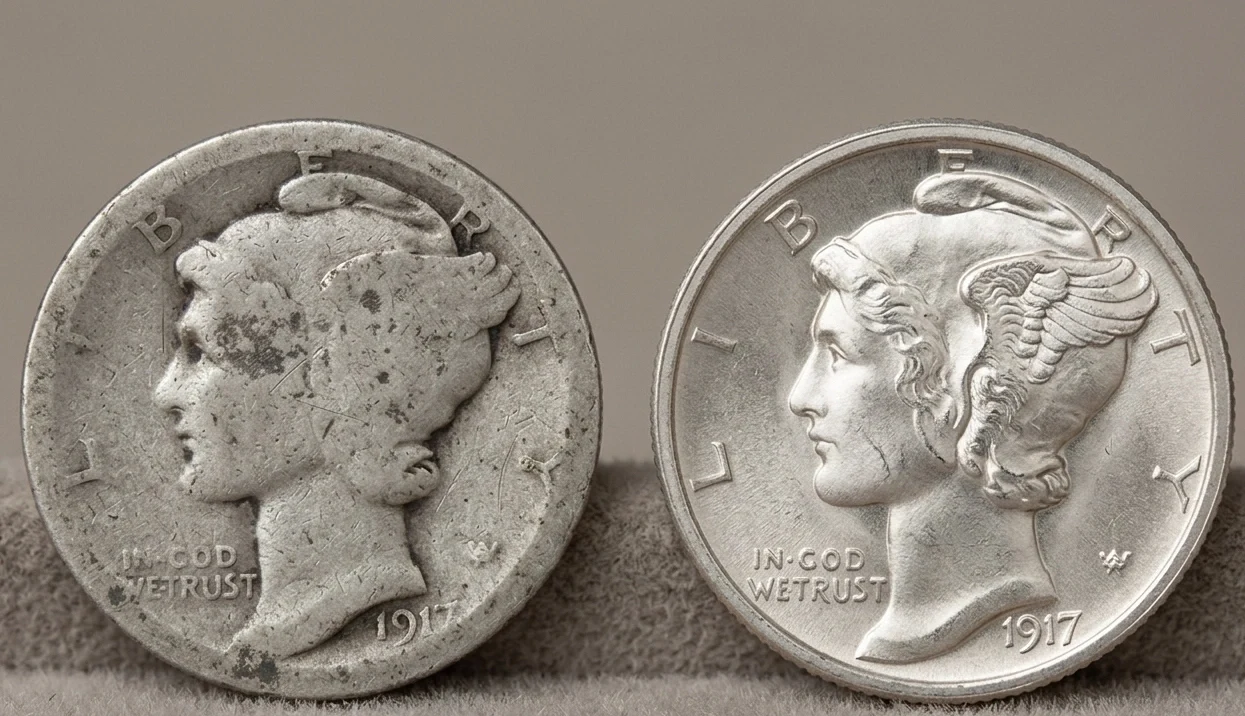
Toning Chemistry and Storage Protocols
The silver-copper alloy reacts sensitively to chemicals in the surrounding air.
Oxidation can either create added value or destroy the coin’s surface.
- Rainbow Toning: A thin oxide film that reflects all spectrum colors. Boosts price by 20–50%.
- Dark Sulfide Crust: A thick, opaque layer that kills the shine. Reduces price by 30%.
- Cleaned Surface: Total lack of patina, usually indicating the use of harsh acids.
Storage in PVC-based holders triggers a sticky green residue.
Protecting an MS67 FB coin in 2026 requires neutral acrylic capsules.
Humidity levels kept at 35% ensure the silver surface remains stable for decades.
San Francisco (S) Mint Characteristics
S-marked specimens possess unique traits that separate them from Eastern mintages.
Experienced graders identify these coins by their specific field luster.
- Surface Texture: Microscopic graininess is often visible from worn dies.
- Mark Location: The small “S” symbol is found on the lower left of the reverse.
- FB Frequency: Found less often than Philadelphia coins but more often than Denver ones.
Current price for a 1917-S in MS66 FB condition is $2,100 as of April 2026.
Demand for these coins remains high among collectors in the Western United States.
Market Demand and Registry Competition
Sales of high-grade 1917 dimes are primarily conducted through specialized houses.
Buying activity in 2026 follows a predictable logic:
- Professional US Collectors: 65% of market volume.
- Investment Funds: 20% (focusing on grades 67 and higher).
- International Dealers: 15% (handling middle-market inventory).
Transition of numismatics into digital spaces has improved pricing transparency.Mobile apps like the free coin appraisal app with instant access to grading registry data have accelerated the trade of rarities.