
Estimating a coin’s price looks simple until real examples appear on the table. A glance at a coin values app shows the general range for a type, yet identical dates rarely behave the same. The reason is clear once you compare the surfaces, the strike, the tone, and the field quality under soft light. Coins that sit one step apart on the grading scale often show wide spreads because each grade represents a specific balance of wear, clarity, and visual strength. Even small differences create noticeable shifts in value.
Collectors who understand these internal divisions read the market more accurately. They see why VF holds steady, why XF moves aggressively, why AU splits into multiple tiers, and why MS behaves as a separate market with its own rules. Here, we would like to explore the logic behind those spreads and offer a practical system to evaluate coins without relying only on labels.
Why Grades Have Value Gaps Even Within the Same Series
Grades do not reflect age or metal. They reflect a surviving condition. A series with millions of pieces can still show scarcity in mid-grade or high-grade ranges. VF and XF may look similar from a distance, yet their price difference grows as collectors compete for coins with cleaner surfaces, sharper details, and more stable fields.
Three elements shape these gaps:
- Wear distribution,
- Surface preservation,
- Visual balance under light.
Coins in the same grade can still diverge because grading compresses many micro-traits into a single label. Understanding this spread prevents overpaying for a flat XF or undervaluing a clean VF that sits above the average for its bracket.
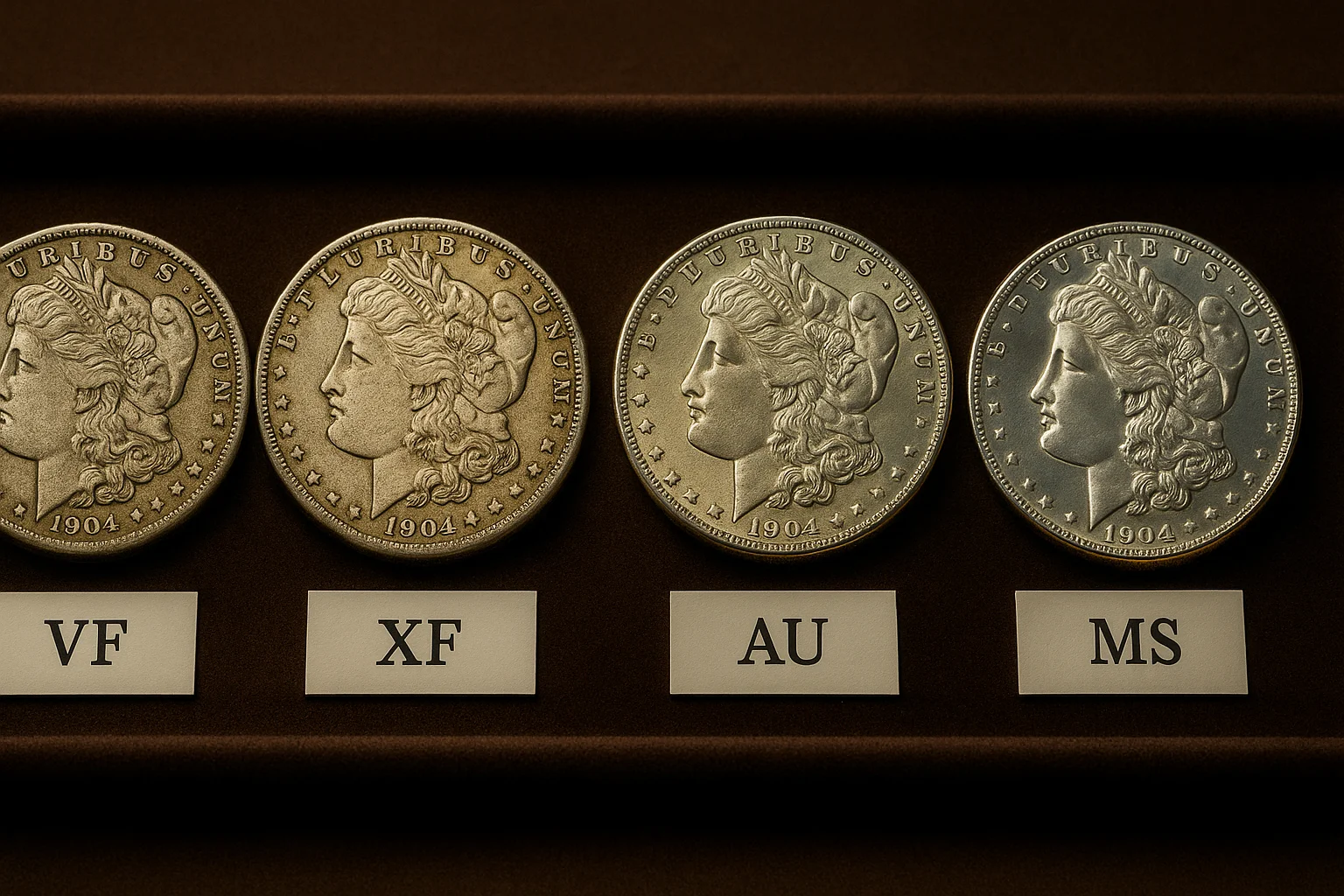
What VF, XF, AU, and MS Actually Represent
Grades describe the remaining detail, not simply wear. Each tier carries expectations that influence price.
VF (Very Fine): The Structure of a Stable Mid-Grade
VF coins show moderate wear across the high points. Major details remain visible. Fields show friction but retain balance. VF often becomes the entry point for classic series because prices stay stable and predictable.
Main expectations in VF:
- Consistent wear across the design,
- Visible primary details,
- Minor marks but no deep scratches,
- Smooth, flat high points with rounded transitions.
VF coins rarely show market jumps unless the series is scarce in any collectable condition. They attract buyers who want clear details without paying XF or AU premiums. At the same time, eye appeal still matters. A clean VF with smooth tone often sells faster than a VF with patchy wear or dull fields.
VF sits at a level where the type becomes readable, but the price remains accessible. This makes it a popular grade for early copper, classic silver, and high-mintage mid-century issues.
XF (Extra Fine): Where Value Starts to Move More Quickly
XF marks the point where the market begins to reward preserved detail. Wear affects only the highest spots. Secondary features remain strong. Fields hold far more life than in VF.
What XF usually includes:
- Sharp design elements with limited flattening,
- Fields that still carry some original texture,
- A more vivid balance between high points and recessed areas,
- Early signs of luster traces on some types.
XF coins often sit in a sensitive price zone. Buyers start evaluating tone, surface colour, and remaining brilliance. XF bridges the gap between circulated and near-uncirculated. This alone increases the price spread within the grade. XF40 looks different from XF45, and auction results reflect that.
Series with low survival in high-grade show strong jumps between VF and XF. XF becomes the grade where collectors begin to compete.
AU (About Uncirculated): The Most Volatile Grade in Pricing
AU behaves as a broad zone with multiple internal tiers. Wear exists but is minimal. Most details remain intact. Surface quality influences price far more than wear itself.
Main AU traits:
- High points show slight friction,
- Devices remain crisp,
- Much of the original luster survives,
- Tone patterns become important to evaluation.
AU50–AU58 covers a wide gap. AU55 and AU58 often approach MS visually. AU53 may still look circulated under light. Because of this, AU has one of the widest internal spreads. Two pieces with the same AU label may differ drastically when compared.
AU is also the grade where strike strength and surface clarity separate the premium pieces from the average ones. A softly struck AU can sit below expectations. A sharply struck AU with clean fields can outperform low MS in some series.
Collectors treat AU as a near-MS class. Prices mirror this behaviour.
MS (Mint State): A Market Formed by Surfaces and Strike
MS coins never entered circulation. Wear does not appear. Pricing depends on preservation, brilliance, tone, and field cleanliness.
Points that define MS:
- No wear on high points,
- Full design structure,
- Surface marks from storage or contact,
- Stability of luster and colour.
The MS market relies heavily on tiny differences. MS60–MS62 may show heavy bag marks. MS63–MS64 improve field clarity and overall appeal. MS65 and above require a strong strike, balanced tone, and consistent luster. This is why MS pricing spreads so widely.
Collectors seek MS examples not only for purity of preservation but also for eye appeal. This creates competition even within narrow grade bands.
Why Condition Spread Creates Wide Price Gaps
Condition influences attention, and attention shapes price. Two coins from the same year behave differently once visual quality enters the picture.
- Condition affects: buyer confidence; perceived rarity within the grade; long-term desirability; speed of sale; auction performance.
Wear follows predictable patterns. Surfaces do not. Tone does not. Strike does not. This combination produces wide spreads even between coins labelled with the same grade.
Collectors who understand these internal differences read the market with more accuracy and avoid paying high MS prices for flat or dull pieces.
Surface Quality: Why Fields Decide the First Price Tier
Surfaces record everything that happened after the strike. Bags, rolls, pockets, and storage containers all leave marks. VF through MS coins carry these marks differently.
A small list shows why surfaces matter:
- Open fields display every flaw,
- Marks on high relief areas show immediately under tilt,
- Tone interacts with marks and either hides or emphasises them,
- Buyers react emotionally to surface cleanliness.
Coins with clean, quiet fields rise above typical prices. Coins with busy or inconsistent fields fall even when graded high. Surface clarity becomes the foundation for further evaluation.
Collectors treat surfaces as the visual handshake. The coin’s first impression starts here.
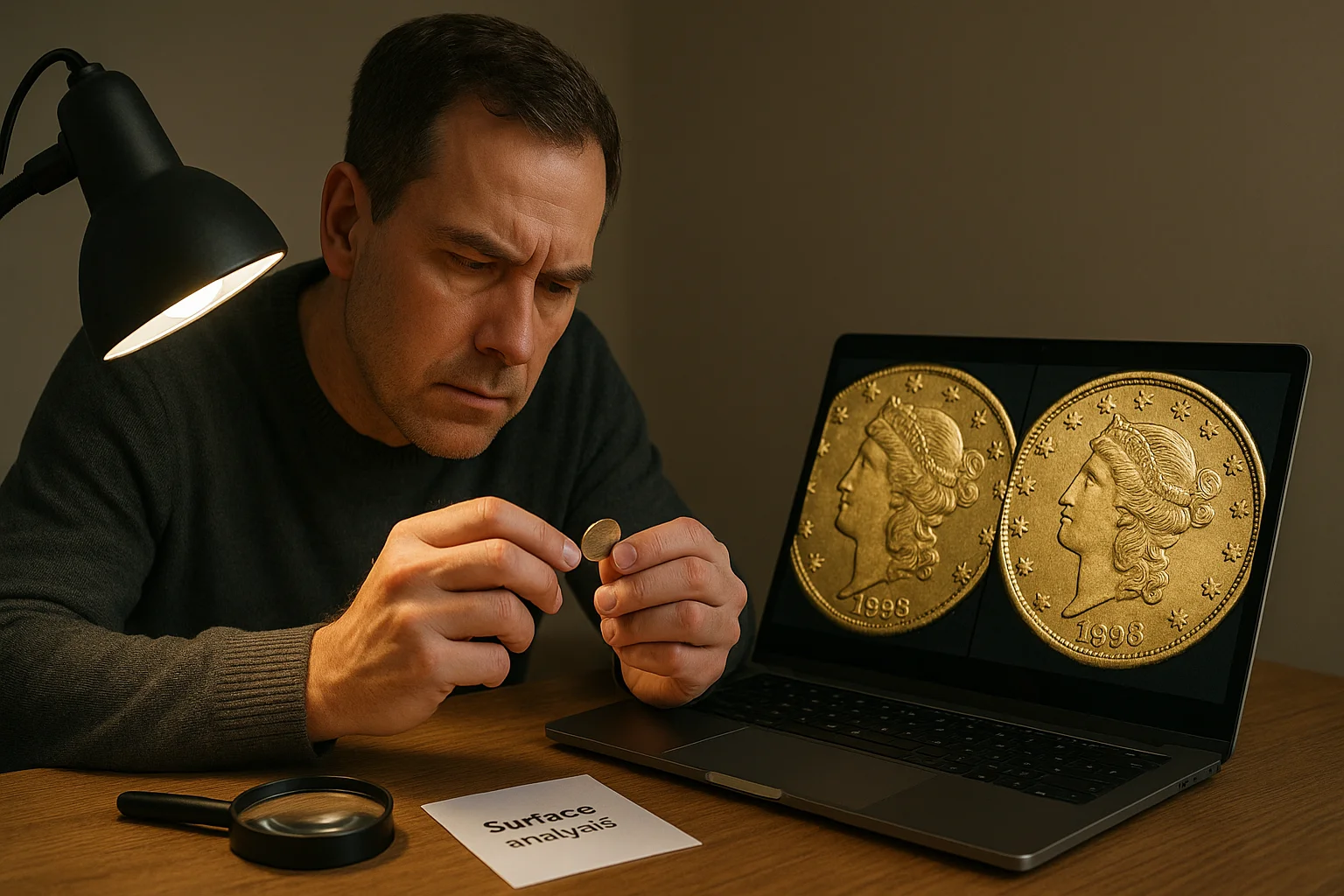
Strike Strength: The Influence That Many Beginners Underestimate
Strike describes how well the die transferred detail into the metal. It has nothing to do with wear, yet it shapes value across all grades.
A short comparison clarifies the gap:
| Feature | Strong Strike | Weak Strike |
| Detail | full and sharp | flat or muted |
| High points | structured | soft, blended |
| Appeal | looks crisp | looks tired |
| Market effect | sells higher | stays lower |
Weak strikes can mislead beginners because they resemble wear. Strong strikes lift the coin visually and place it nearer to the top of the grade scale. Strike gaps appear in almost every U.S. and world series. Understanding them prevents misjudging the price.
Eye Appeal: The Trait That Moves Prices Faster Than the Grade
Eye appeal describes how the coin looks under natural light. It combines luster, tone, colour balance, and field texture. Buyers respond to appearance before any technical detail.
Strong eye appeal includes:
- Steady brightness,
- Clean transitions between devices and fields,
- Soft, even tone,
- Balanced colour.
Coins with positive appeal sell faster and at higher prices in the range. Coins with dull or uneven appearance move slowly, even when graded well.
Eye appeal often explains why one XF coin sells instantly, and another remains unsold at a discount.
How Apps Fit Into the Condition Evaluation Process
Digital tools help with the identification stage. A coin identification app recognises the type, confirms the version, and displays expected specifications. This prevents confusing similar designs and helps place the coin within its correct series before condition checks begin.
The app also provides a baseline range for the type. This helps set expectations before examining the specimen. It does not rate the specific coin. It does not read tone, friction, or strike depth.
Apps serve the same role when working with world coins or mixed lots. They reduce sorting time and classify pieces correctly before deeper evaluation.
Coin ID Scanner supports this step by confirming the correct type and verifying primary parameters. Its role is limited to early classification. Physical inspection always determines the actual value.
How to Read Condition Spread and Price Coins Accurately
Evaluating a coin across VF, XF, AU, and MS grades requires a consistent method. This prevents bias and forces the collector to focus on real traits rather than the label.
A simple strategy helps:
- Check the design strength under light.
- Compare high points to see where wear begins.
- Read the fields for marks, texture, and smoothness.
- Evaluate tone for consistency and natural character.
- Judge strike and identify weak areas unrelated to wear.
- Compare with auction results from the same grade range.
- Place the coin within the bracket based on surface strength and appeal.
This process works across all metals and all eras.
Conclusion: Condition Spread Is the Core of Real Pricing
Coins never move in a straight price line. Small changes in surfaces, strike depth, tone, or wear create wide differences between VF, XF, AU, and MS. Grades set the outline, but the condition of the actual coin decides the number.
Remember that the coin value checker app gives the first frame. It confirms the correct type and shows where the series usually sits on the market. The real work starts afterwards, when the collector checks the fields, reads the strike, studies the tone, and compares the piece with completed sales. This is the moment when the true value becomes clear.